
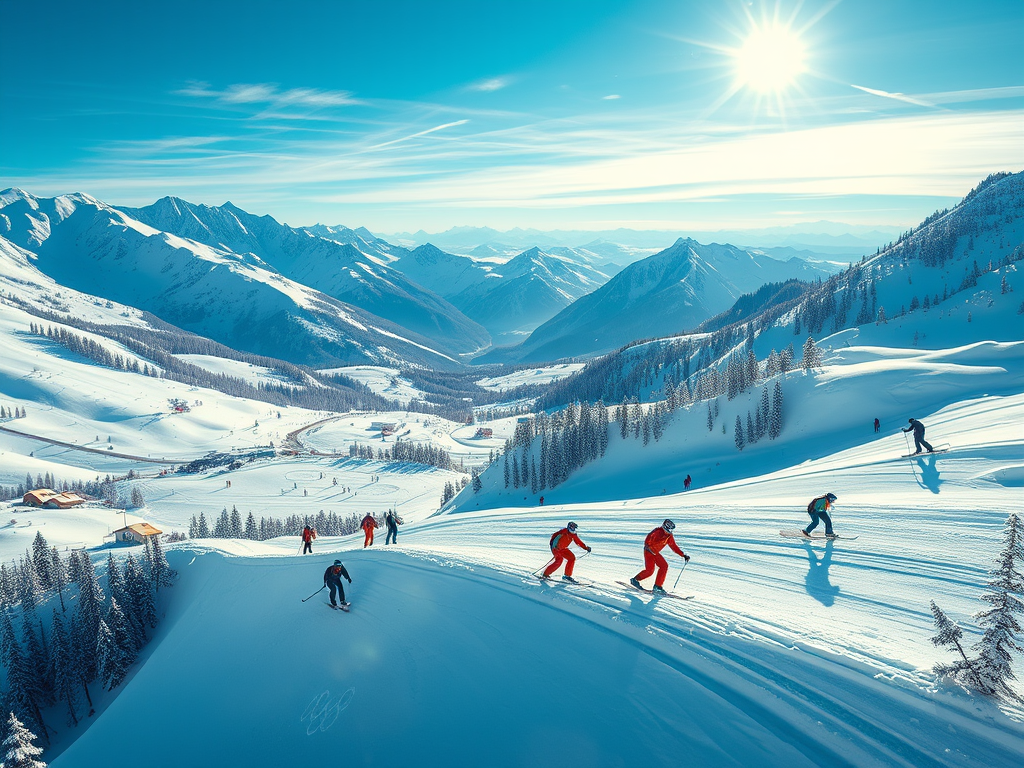
Winter Olympics sports explained – your ultimate A-Z guide to Milano Cortina 2026.
The 2026 Winter Olympics takes place in Italy in February with 16 sports spread across two-and-a-half weeks.
February 6-22 will see more than 90 Olympic nations – and almost 3000 athletes – compete in the picturesque Italian Alps.
Here is an easy guide to Winter Olympics sports ahead of February.
winter olympic sports explained
alpine skiing
downhill
Downhill is an exhilarating watch with competitors reaching supersonic speeds as they weave their way to the bottom.
Skiers reach speeds in excess of 100 km/h as they navigate jumps, extremely steep drops and gates along the route.
Athletes have just one run to clock the fastest time as they hurtle towards the finish line.
giant slalom
Giant Slalom is won over a combined time across two runs – with only competitors who finish the first run joining the second half.
Gates are a lot closer together and much wider than in downhill.
slalom
Slalom is the shortest race in Alpine Skiing, with gates replaced for poles.
Skiers have to touch each pole on the way down the course, with twists and turns coming in extremely quick succession.
super g
Super Giant Slalom mixes speed and agility as skiers race through double gates on their descent.
The competition takes place on the same slope as the downhill event, but has much wider and more frequent turns.
biathlon
Biathlon incorporates cross-country skiing and rifle shooting.
Skiers race around a circuit, shooting at targets in the standing and prone positions every lap.
Missed targets equal either a distance or time penalty.
Fastest time to complete the course wins.
bobsleigh
The two-person and four-person bobsleigh events are contested by both men and women – with a monobob event for women only.
Monobob is an individual athlete, while two and four-person events have a pilot and brake person – with an extra two athletes for the four-person event.
The crew push the sleigh to the start line at pace, before jumping in and navigating a downhill slide.
The winner is the fastest total time across four heats – with only the top 20 making it into the fourth and final round.
cross-country skiing
Cross-country skiing is contested using either classic or freestyle technique.
Classic sees competitors glide across tracks in the snow – freestyle allows the skier to ‘skate’ in the direction of travel.
In all but the men’s and women’s 10km free events, the winner is first to cross the finish line.
In 10km free, athletes have a staggered start and it’s fastest time wins.
curling
Curling is contested over 10 ends – with eight stones per team played each end.
after all 16 stones are played, the stone closest to the centre scores the team a point.
If a team has more than one stone closer than their opposition’s best, they also gain a point for each one.
The team with the most points at the end of the final round wins.
figure skating
Figure skating sees athletes dance on ice – just like Dancing On Ice, actually.
Men and Women compete in singles, pairs and as a team, with highest scores from the judges winning.
Performances are set to music and have a mix of mandatory elements and freedom to showcase their individuality.
Scores are based on both technicality and execution.
freestyle skiing
aerials
Skiers launch into the air from a ramp, performing acrobatic tricks which are scored by a judging panel.
big air
Big air is aerials on steroids.
Athletes ski downhill towards a huge ramp, performing incredible aerial tricks, before landing.
dual moguls
Dual moguls is moguls for two.
New for the 2026 Games, athletes compete against each other on the same course.
halfpipe
halfpipe sees skiers perform tricks as they hit the air at either end of a semi-circular ramp.
moguls
Mogul courses are full of bumps, turns, jumps and speed.
Winners are judged by a highest score comprising of their turns, air and speed through the course.
ski cross
Ski cross competitors qualify for a final, where four athletes compete together for the win.
The course includes jumps, bumps and curves – fastest to the finish wins.
slopestyle
Slopestyle combines rails and jumps in a course much like a skate park.
Skiers’ tricks are judged on their originality, versatility and execution.
ice hockey
Ice Hockey is played across three 20-minute periods, with the winner being the team who scores the most goals.
Six players are on the ice for each team, including one dedicated goaltender.
Players swap regularly, and if pushing for a goal, teams can replace their goaltender with another skater.
If the game is a tie, group stage games go into overtime and a shootout – the final is golden goal.
luge
Luge is comprised of single, double and relay events.
In singles and doubles, either one or two competitors lay on their sled on their back and navigate a downhill course full of twists and turns.
In relay, male and female singles and doubles take it in turns to slide to the bottom, with the next one going once they reach the end.
The winners are the best individual or combined times.
nordic combined
Nordic combined consists of a ski jump and cross-country race.
The distance jumped determines when the skiers start and first to the finish wins.
short track speed skating
In short track, skaters compete against each other in elimination rounds.
Tight turns at high speeds are often a recipe for spectacular crash-outs.
In 500m and 1000m races five competitors face off – with seven in the 1500m.
Two women and two men make up the mixed relay teams.
skeleton
Skeleton, unlike luge, sees competitors slide down the chute head first.
Reaching speeds in excess of 100km/h, this event is not for the faint-hearted
much like the luge, skeleton competitions take place over multiple runs – fastest overall wins.
ski jumping
50 competitors take part in an opening jump – with top 30 advancing to the final.
Skiers hurtle downhill before launching from a ramp and flying through the air for as far as possible.
Jumps are scored by judges, based on distance travelled and style of the performance.
The highest total across two jumps wins.
ski mountaineering
Ski mountaineering consists of an ascent and descent across challenging terrain.
competitors begin uphill on skis, before navigating normal steps, then back on skis to the summit.
Climbing skins on the skis are then removed for a downhill descent to the finish.
Skiers compete across elimination round before a final deciding the medals.
snowboarding
big air
Snowboarders hurtle towards a large ramp before hitting the air and performing a range of aerial tricks.
halfpipe
In the halfpipe, competitors perform a series of tricks while snowboarding down a slope with a semi-cylindrical shape. They are scored on the breadth and difficulty of the jumps.
Halfpipe competitors perform a series of tricks as they launch off either end of a semi-circular ramp.
parallel giant slalom
Two snowboarders race parallel downhill through the course with a race to the finish.
Each competitor rides down a red and blue track, with the combined times deciding whether or not they advance.
slopestyle
Slopestyle is a ride down a skateboard-type course with rails and jumps and are judged on variety, originality and quality of their tricks.
snowboard cross
Four athletes compete directly across a track with jumps, moguls and curves, with the fastest two progressing – until the final four.
speed Skating
A speed skating track is 400m long – as opposed to short-track – and skaters have a single shot at recording the best possible time.
Mass start competitions include heats while the team pursuit includes three athletes in elimination races.

Enjoyed our basic guide to Milano Cortina 2026? Visit the official website HERE.
Leave a Reply